
Open Access for Department of Clinical Medicine

On this page, you can read about Open Access, including the agreements and services available to you as a researcher at IKM and across the rest of UCPH.
If you have questions that you cannot find the answer to on this page, please feel free to contact us.
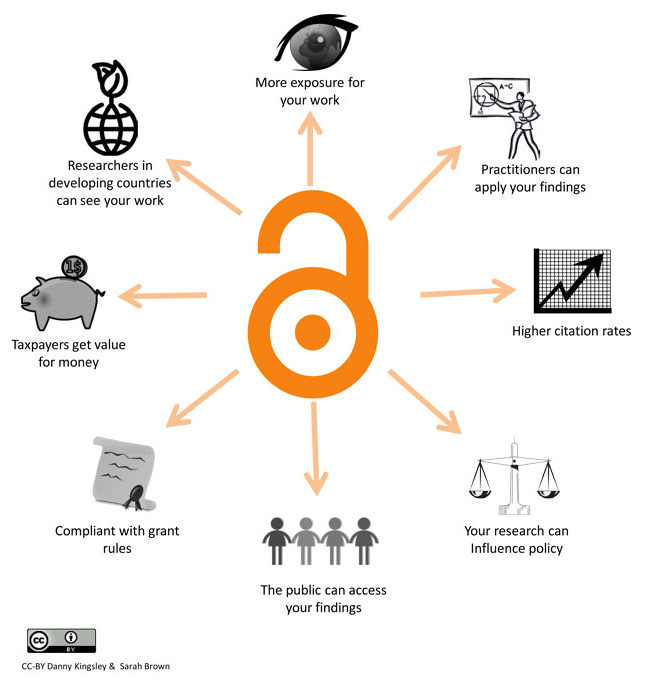 Open Access is a publishing model where free and unhindered access to research publications is provided, as opposed to subscription publication channels, where payment is required for access. This means that the research will be open and accessible to all those interested at no cost and without subscription.
Open Access helps to increase the spread of research and reach a larger readership as well as increase the opportunities for more citations. Open Access publications are generally licensed under a Creative Commons license which makes it easier to distribute, share and adapt the publications depending on the license terms.
Several funders require that the research that they grant money to is published as Open Access, e.g. EU funding programs, Horizon 2020 and Horizon Europe.
As a department at University of Copenhagen, IKM has joined Denmark’s National Strategy for Open Access.
Green Open Access
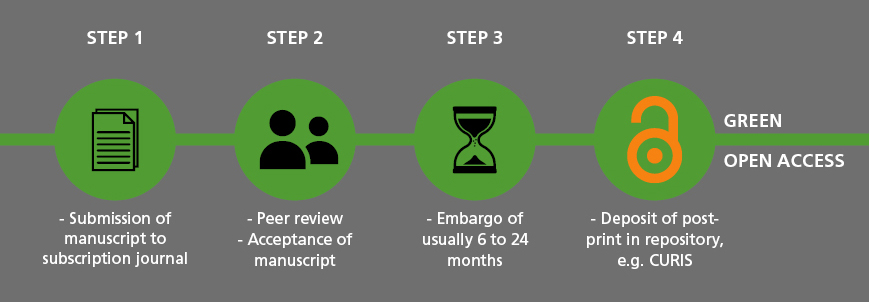
When publishing Green Open Access, the author makes a traditional publication, usually in a journal, and either simultaneously or later deposits a manuscript version of the article in CURIS, alternatively another open archive (e.g. arXiv.org or PubMed Central). The deposited manuscript is usually the peer reviewed postprint.
It is free of charge to publish Green Open Access, but post-prints are generally subject to an embargo period of 6 to 24 months.
You can submit your manuscript for upload in CURIS via this form.
Copenhagen University Library recommends that you use the form instead of uploading your manuscripts to CURIS yourself. The library will ensure correct metadata and that the access to the manuscripts follows any embargo periods set out by the publisher.
See example of Green Open Access (post-print in CURIS)
Gold Open Access
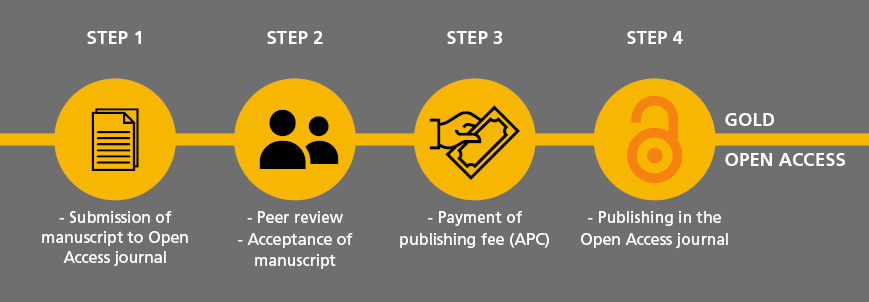
Gold Open Access is publishing in pure Open Access journals, where the access to all articles are unhindered and free of charge. Golden Open Access journals usually operate with a publishing fee, a so-called APC (Article Processing Charge) for publishing articles. The APC is usually paid by funders, the authors' institutions, or the authors themselves.
DOAJ (Directory of Open Access Journals) is a database with information on Golden Open Access journals, including APC costs and Creative Commons license, and you can search for subject-specific journals.
See example of Gold Open Access
Hybrid Open Access
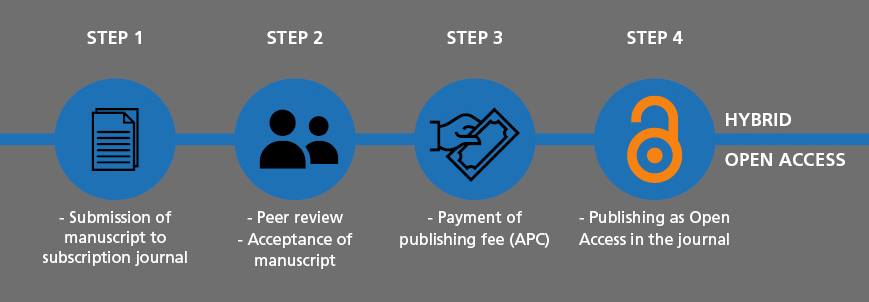
Hybrid Open Access is when individual articles are paid for to be released as Open Access. Thus, Articles in Hybrid Open Access journals will be a mix of both Open Access articles and toll articles. The majority of the traditional academic subscription journals provide the opportunity to publish Open Access by payment of an APC.
See example of Hybrid Open Access
As a UCPH researcher, you have the option to publish without APC, in other words for free, in a number of Hybrid Open Access journals published by Cambridge University Press, Elsevier, IOP, Springer and Wiley.
Diamond Open Access
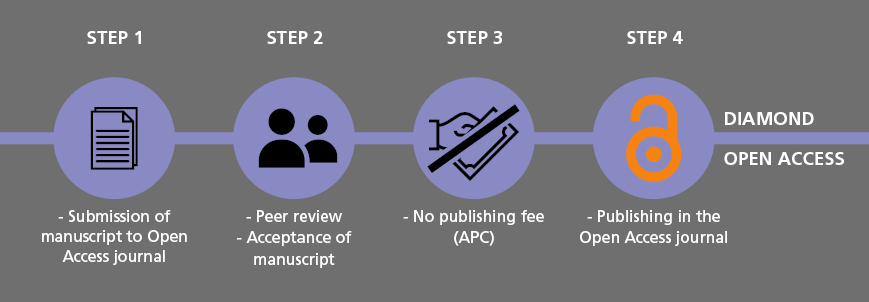
Diamond Open Access is publishing in Open Access journals that do not operate with an APC. Therefore, it is free to publish in Diamond Open Access journals.
Diamond Open Access journals and their platforms are normally funded or operated by research institutions, foundations or university libraries.
In 2022, Science Europe, cOAlition S, OPERAS and the French National Research Agency launched the "Action Plan for Diamond Open Access", which works to develop and strengthen the possibilities for APC-free publishing.
In DOAJ (Directory of Open Access Journals) you can search for subject-specific Diamond Open Access journals.
It is a requirement of both the EU and the Danish public funds that all publications that are results of these grants are published as Open Access.
Before entering into an agreement on publication, it is important to examine whether the publisher/journal actually allows Open Access publishing and with the conditions laid down by the grantor.
Click on the name of the fund below to read more about the fund's Open Access requirements. The information below is indicative and changes may occur.
Public funds
Private funds
- The Carlsberg Foundation
- The Danish Cancer Society
- The Lundbeck Foundation
- Novo Nordisk Foundation
- TrygFonden
- VELUX FONDEN and VILLUM FONDEN
EU
Independent Research Fund Denmark
As a public fund, Independent Research Fund Denmark follows the Open Access policy for public research foundations:
- Open Access requirements apply to articles only.
- Both post-print (the accepted manuscript) and publisher’s final version (VoR) are accepted.
- Maximum 6 month embargo.
- No Creative Commons license required.
- The final publication – either post-print or VoR – must be made available in an institutional or subject-specific repository
Read the Open Access policy for public sector research funds and foundations.
The Danish National Research Foundation
As a public fund, The Danish National Research Foundation follows the Open Access policy for public research foundations:
- Open Access requirements apply to articles only.
- Both post-print (the accepted manuscript) and publisher’s final version (VoR) are accepted.
- Maximum 6 month embargo.
- No Creative Commons license required.
- The final publication – either post-print or VoR – must be made available in an institutional or subject-specific repository
Read the Open Access policy for public sector research funds and foundations.
Innovation Fund Denmark
As a public fund, Innovation Fund Denmark follows the Open Access policy for public research foundations:
- Open Access requirements apply to articles only.
- Both post-print (the accepted manuscript) and publisher’s final version (VoR) are accepted.
- Maximum 6 month embargo.
- No Creative Commons license required.
- The final publication – either post-print or VoR – must be made available in an institutional or subject-specific repository
Read the Open Access policy for public sector research funds and foundations.
The Carlsberg Foundation
The Carlsberg Foundation has requirements for Open Access and has joint the Open Access policy for public research foundations:
- Open Access requirements apply to articles only.
- Both post-print (the accepted manuscript) and publisher’s final version (VoR) are accepted.
- Maximum 6 month embargo.
- No Creative Commons license required.
- The final publication – either post-print or VoR – must be made available in an institutional or subject-specific repository.
The Danish Cancer Society
The Danish Cancer Society has requirements for Open Access and has joint the Open Access policy for public research foundations:
- Open Access requirements apply to articles only.
- Both post-print (the accepted manuscript) and publisher’s final version (VoR) are accepted.
- Maximum 6 month embargo.
- No Creative Commons license required.
- The final publication – either post-print or VoR – must be made available in an institutional or subject-specific repository.
Read The Danish Cancer Society's Open Access policy..
The Lundbeck Foundation
No requirements for Open Access.Novo Nordisk Foundation
No requirements for Open Access.TrygFonden
TrygFonden encourages Open Access and for applicants to apply for coverage of APCs.
VELUX FONDEN and VILLUM FONDEN
VELUX FONDEN and VILLUM FONDEN have requirements for Open Access and have joint the Open Access policy for public research foundations:
- Open Access requirements apply to articles only.
- Both post-print (the accepted manuscript) and publisher’s final version (VoR) are accepted.
- Maximum 6 month embargo.
- No Creative Commons license required.
- The final publication – either post-print or VoR – must be made available in an institutional or subject-specific repository.
EU Horizon Europe
Horizon Europe has requirements for Open Access:
- All publications must be made available as Open Access.
- Both post-print (the accepted manuscript) and publisher’s final version (VoR) are accepted.
- Embargo is not permitted.
- Publications must be published with the Creative Commons license CC BY. Monographs and anthologies can be licensed with more closed licenses, e.g. CC BY-NC, CC BY-ND etc.
- The final publication – either post-print or VoR – must be made available in a trusted repository for scientific publications, such as Zenodo.
- APCs can only be covered if publications are published in full Open Access journals (Gold Open Access journals). Although publishing Open Access in Hybrid journals is allowed, APCs for publishing in Hybrid journals cannot be covered by the EC funding.
Read the Open Access requirements of Horizon Europe (p. 381).
EU Horizon 2020
Horizon Europe has requirements for Open Access:
- All publications must be made available as Open Access.
- Both post-print (the accepted manuscript) and publisher’s final version (VoR) are accepted.
- Maximum 6 month embargo.
- No Creative Commons license required.
- The final publication – either post-print or VoR – must be made available in a trusted repository for scientific publications, such as Zenodo.
- APCs can only be covered during the project.
Contact support
Copenhagen University Library Research Support
oa.ucph@kb.dk
If your inquiry concerns the APC waiver agreements and you don't have an UCPH affiliation, please write to kblicenser.rigshospitalet@regionh.dk